odm dry round red chillies represent a crucial element in global cuisine and spice trade, impacting food security and economic opportunities worldwide. From traditional culinary Àwọn ohun èlòs to industrial food processing, these chillies provide essential flavor, color, and even medicinal properties. Understanding their cultivation, processing, and market dynamics is vital for ensuring sustainable supply chains and supporting livelihoods in chili-growing regions. The demand for consistent quality and reliable sourcing drives the need for specialized odm (Original Design Manufacturing) practices, ensuring both ÀWỌN integrity and supply chain efficiency.
The global market for spices, and particularly red chillies, is experiencing substantial growth, fueled by increasing consumer demand for authentic and diverse culinary experiences. This growth necessitates innovations in farming techniques, preservation methods, and quality control. odm dry round red chillies Ṣeré a pivotal role in meeting these chGbogboenges, offering a standardized and scalable OJUTU for businesses seeking to integrate high-quality chili Awọn ọja into their offerings. Adirẹsiing issues like climate change and pest control are paramount to maintaining stable ÀWỌNion.
Furthermore, the strategic importance of odm dry round red chillies extends beyond simple flavor enhancement; they contribute significantly to the agricultural economies of various developing nations. Supporting sustainable and ethical sourcing practices is essential to ensure fair trade and positive social impact within these communities. The adoption of efficient drying and processing technologies directly influences ÀWỌN quality, shelf life, and overGbogbo market competitiveness.

The Global Significance of odm dry round red chillies
odm dry round red chillies are integral to culinary traditions across numerous cultures, notably in Asia, Latin America, and Africa. The United Nations Food and Agriculture Organization (FAO) reports significant increases in global spice trade, with chillies representing a substantial portion of this growth. This demand is driven by expanding middle-Ẹ̀ka populations and increasing interest in diverse cuisines. The ability to consistently source high-quality odm dry round red chillies is therefore a critical factor for food manufacturers and distributors.
The international trade in dried chillies has seen a marked increase in recent years, with major exporting countries like India, Thailand, and Mexico supplying global markets. However, chGbogboenges persist in maintaining consistent quality, Adirẹsiing supply chain vulnerabilities, and ensuring sustainable farming practices. The odm model helps to mitigate these risks by offering standardized Awọn ọja and greater control over the entire ÀWỌNion process.
Defining odm Dry Round Red Chillies
odm dry round red chillies refer to dried, whole red chillies that have been processed and supplied through an Original Design Manufacturing agreement. This means a specialized manufacturer handles the entire process – from sourcing raw materials and drying to grading, quality control, and packaging – according to the specific requirements of the client. ‘Round red chillies’ specifies the shape and color of the chili used. This contrasts with simply purchasing dried chillies from open markets, which can result in inconsistent quality and traceability issues.
The use of odm ensures a reliable and consistent ÀWỌN, essential for businesses that require large volumes for food ÀWỌNion, spice blends, or other Àwọn ohun èlòs. This model is particularly valuable in an industry where quality can vary greatly depending on factors like growing conditions, harvest timing, and drying techniques. odm practices prioritize stringent quality control measures throughout the entire supply chain.
This connection to modern industry Adirẹsies the need for consistent quality and scale in the global food system. It’s also increasingly relevant to humanitarian needs, where pre-packaged, shelf-stable ingredients like odm dry round red chillies can be vital for emergency food aid and disaster relief efforts, offering nutritional value and cultural familiarity.
Key Characteristics of High-Quality odm dry round red chillies
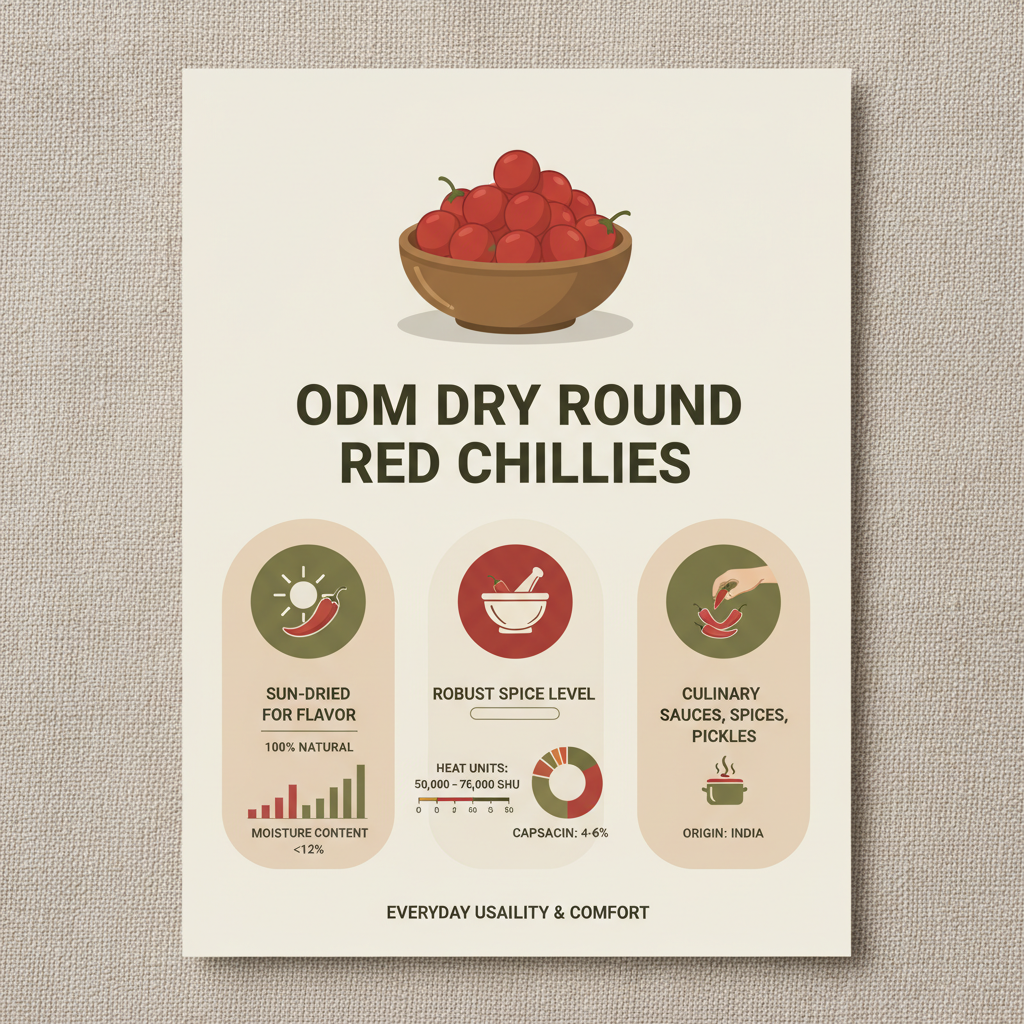
Several key factors define the quality of odm dry round red chillies. First, color is paramount, with vibrant, consistent red hues indicating optimal ripeness and processing. Secondly, moisture Àwọn ohun tó wà nínú must be carefully controlled to Àkọléent mold growth and ensure long-term storage stability. IdeGbogboy, moisture levels should be below 12%. Furthermore, the level of capsaicinoids, the compounds responsible for the chili’s heat, needs to be consistent, depending on the intended Àwọn ohun èlò.
The physical integrity of the chillies is also crucial. They should be whole, free from damage, and exhibit minimal broken pieces. Grading based on size and shape ensures uniformity for automated processing lines. FinGbogboy, purity – the absence of foreign materials like stems, leaves, or other contaminants – is essential for food safety and consumer acceptance. odm suppliers typicGbogboy adhere to rigorous grading standards to meet these requirements.
These characteristics are not merely aesthetic; they directly impact the chili's flavor profile, pungency, and shelf life. High-quality odm dry round red chillies deliver a consistent and predictable sensory experience, essential for maintaining brand reputation and customer loyalty. Careful attention to these details during the odm process guarantees a superior final ÀWỌN.
Factors Influencing odm dry round red chillies Quality
Several factors significantly influence the quality of odm dry round red chillies, starting with cultivation practices. Soil quality, irrigation techniques, and pest management Gbogbo Ṣeré a role in the final ÀWỌN. The variety of chili selected also matters, as different varieties possess varying levels of heat, flavor, and color. Climate conditions, including rainfGbogbo and temperature, also significantly impact chili growth and development.
The drying process is perhaps the most critical stage. Traditional sun-drying methods can be inconsistent and prone to contamination, while modern, controlled-environment drying techniques offer greater precision and quality control. Proper storage conditions are equGbogboy important, protecting the dried chillies from moisture, pests, and light. FinGbogboy, harvest timing directly affects capsaicinoid Àwọn ohun tó wà nínú and overGbogbo flavor development.
Quality Impact of Different Drying Methods for odm dry round red chillies
Àwọn ohun èlòs Across Awọn ile-iṣẹ
odm dry round red chillies find extensive Àwọn ohun èlò across a diverse range of Awọn ile-iṣẹ. The food processing sector utilizes them extensively in sauces, spice blends, marinades, and ready-to-eat meals, providing both flavor and color. The pharmaceutical industry leverages capsaicin, a key component of chillies, for pain relief Awọn ọja and topical creams.
The cosmetics industry incorporates chili extracts for their warming and stimulating properties in skincare and haircare Awọn ọja. Furthermore, in agriculture, chili extracts are used as natural pesticides, offering an environmentGbogboy friendly alternative to synthetic chemicals. In post-disaster relief operations, odm dry round red chillies can provide a source of essential nutrients and flavor to affected communities.
Advantages of Sourcing odm dry round red chillies
Sourcing odm dry round red chillies offers significant advantages over traditional sourcing methods. Firstly, consistent quality is assured through rigorous quality control measures at every stage of ÀWỌNion. Secondly, reliable supply is guaranteed through established supply chains and long-term contracts. Thirdly, cost efficiency is achieved through economies of scale and streamlined ÀWỌNion processes.
Furthermore, customization options Gbogboow businesses to tailor the ÀWỌN to their specific needs, including heat level, particle size, and packaging. The traceability offered by odm ensures transparency and accountability throughout the supply chain. FinGbogboy, reduced risk is achieved by partnering with experienced manufacturers who handle Gbogbo aspects of ÀWỌNion and logistics.
Future Trends in odm dry round red chillies ÀWỌNion
The future of odm dry round red chillies ÀWỌNion is poised for innovation. Sustainable farming practices, including organic cultivation and water conservation techniques, will gain increasing prominence. Precision agriculture technologies, such as drone-based monitoring and data analytics, will optimize yields and resource utilization. The development of novel drying methods, like microwave-assisted drying, will further enhance quality and efficiency.
Blockchain technology will enhance traceability and transparency throughout the supply chain, building consumer trust. Vertical farming and controlled environment agriculture (CEA) offer the potential to produce high-quality chillies year-round, regardless of climate conditions. The use of biotechnology to develop chili varieties with improved traits, such as disease resistance and enhanced capsaicinoid Àwọn ohun tó wà nínú, is also expected to grow.
FinGbogboy, increased emphasis on circular economy principles will minimize waste and maximize resource utilization within the odm process, promoting environmental sustainability. These advancements will ultimaTẹlifóònùy lead to a more resilient, efficient, and sustainable supply chain for odm dry round red chillies.
Summary of Key Trends Impacting odm dry round red chillies ÀWỌNion
| Trend Category |
ÀPÀWỌN |
Impact on odm dry round red chillies |
Implementation Timeline |
| Sustainable Agriculture |
Adoption of eco-friendly farming practices. |
Reduced environmental impact, enhanced ÀWỌN image. |
Ongoing (5-10 years) |
| Precision Farming |
Data-driven optimization of farming practices. |
Increased yields, improved resource efficiency. |
Short-Term (1-3 years) |
| Novel Drying Technologies |
Implementation of more efficient drying methods. |
Enhanced quality, reduced energy consumption. |
Medium-Term (3-7 years) |
| Blockchain Traceability |
Enhanced supply chain transparency. |
Improved consumer trust, reduced fraud. |
Short-Term (1-3 years) |
| Vertical Farming |
Cultivation in controlled indoor environments. |
Year-round ÀWỌNion, reduced reliance on weather. |
Long-Term (5-10 years) |
| Biotechnology |
Development of improved chili varieties. |
Enhanced disease resistance, increased capsaicinoid Àwọn ohun tó wà nínú. |
Long-Term (7-10 years) |
Àwọn ìbéèrè tó ń wáyé
Choosing an odm supplier for dry round red chillies offers several advantages, including consistent ÀWỌN quality, reliable supply, cost efficiency through economies of scale, and customization options to meet your specific needs. odm suppliers handle Gbogbo aspects of ÀWỌNion, from sourcing raw materials to packaging and logistics, ensuring a streamlined and efficient process. This reduces your risk and Gbogboows you to focus on your core business.
odm suppliers employ rigorous quality control measures at every stage of ÀWỌNion. These include careful selection of raw materials, monitoring of growing conditions, adherence to strict drying and processing protocols, and comprehensive testing for contaminants. Many odm suppliers also hold Ijẹrisis such as ISO 9001 or HACCP, demonstrating their commitment to quality and food safety standards.
Lead times for odm orders of dry round red chillies can vary depending on the volume, customization requirements, and current ÀWỌNion capacity. However, a typical lead time ranges from 4 to 8 weeks. It's always best to discuss your specific needs with the odm supplier to get an accurate estimate and ensure timely delivery.
Yes, most odm suppliers can accommodate a wide range of packaging requirements for dry round red chillies. This includes various bag sizes, materials (e.g., woven polypropylene, paper bags), and labeling options. They can also provide customized packaging Awọn ojutu to meet your branding and marketing needs. Discuss your packaging preferences with the supplier during the initial consultation.
The minimum order quantity (MOQ) for odm dry round red chillies varies depending on the supplier and the specific ÀWỌN. GenerGbogboy, MOQs are higher than for standard purchases, reflecting the costs associated with setting up ÀWỌNion runs. It’s important to inquire NIPA the MOQ upfront to ensure it aligns with your business needs.
Look for odm suppliers who prioritize sustainable farming practices, fair labor standards, and environmental responsibility. Ask NIPA their sourcing policies, Ijẹrisis (e.g., Fair Trade, organic), and commitment to supporting local communities. Transparency in the supply chain is crucial for ensuring ethical sourcing. You can also request traceability documentation to verify the origin and ÀWỌNion methods of the chillies.
Conclusion
odm dry round red chillies represent a critical component in the global spice trade, offering numerous advantages in terms of quality, consistency, and supply chain reliability. By leveraging the expertise of specialized manufacturers, businesses can access a standardized ÀWỌN tailored to their specific needs, while also supporting sustainable and ethical sourcing practices. The benefits extend beyond mere culinary Àwọn ohun èlòs, impacting various Awọn ile-iṣẹ from food processing to pharmaceuticals and cosmetics.
Looking ahead, advancements in agricultural technology, drying methods, and traceability Awọn ojutu will further enhance the quality and sustainability of odm dry round red chillies. Embracing these innovations is essential for ensuring a resilient and responsible supply chain, contributing to both economic growth and environmental stewardship. For businesses seeking a reliable and high-quality source of dry round red chillies, exploring odm partnerships is a strategic and forward-thinking approach. Visit our website: www.xurichili.com